

Dental Prosthetics
What Is a Dental Prosthesis?
A dental prosthesis is a treatment for people who have lost teeth. When teeth are lost for various reasons, artificial teeth are used to restore chewing, speaking and aesthetics. Dental prostheses can be fixed in the mouth or removable, and they can be made from different materials.
Fixed prostheses or bridges can be made to protect a tooth that has been damaged for various reasons or to fill the gap left by a missing tooth. The teeth are reduced in size and precise impressions are taken; the restorations are then crafted in the laboratory to fit the individual and bonded in the clinic using special adhesives.
Dental prostheses, defined as artificial teeth that replace missing ones, can be made in different forms and from different materials depending on the person’s mouth and tooth structure, the number and position of missing teeth, or the degree of damage to the tooth. At this stage, dental prostheses vary according to the patient’s needs and aesthetic expectations, so that the most suitable solution can be chosen.
Fixed Prostheses
Fixed prostheses, also known as bridges, crowns or caps, are used when a small number of teeth are missing. The supporting teeth are reduced in size, and the prostheses are prepared in the laboratory and bonded to the teeth.
Fixed prostheses, which are either supported by the patient’s natural teeth or placed directly on them, are dental treatments focused on correcting missing teeth and the aesthetic problems associated with them. Among dental prostheses, fixed prostheses are the closest to the natural tooth form; because they do not move in the mouth, they mimic permanent teeth. Patients generally find them easier to accept than removable prostheses, but certain conditions must be met for them to be applied. After the teeth are prepared and impressions are taken, the procedure is completed in 2 to 3 sessions over about 1 week.
Fixed prostheses are mainly divided into crowns and bridges.
Crown
A crown is a fixed prosthesis made for a single tooth. The natural tooth is reduced in size, and the crown (cap) is bonded onto it with a special adhesive; it cannot be removed by the patient. It is usually made to protect the tooth.
Bridge
A bridge is a fixed prosthesis used to fill the gap when one or more teeth are missing; the neighboring teeth are reduced in size and used as support.
What happens if missing teeth are not replaced?
Teeth tend to move when there is a gap. If a bridge is not made, the patient’s neighboring teeth and the opposing tooth in the other jaw move toward the extraction gap. As a result, the balance in the mouth is disturbed, which can lead to tipping of teeth, gaps that are difficult to clean and therefore decay, aesthetic deterioration, bone loss and tooth loss. If this gap is not restored with an implant or a bridge for a long time, the neighboring teeth may also be lost. In addition, depending on the location of the missing tooth, it can lead to reduced chewing ability and speech problems.
Fixed prostheses rely on the natural tooth itself or on its support, so they are not suitable for every type of tooth loss. For a fixed prosthesis to be applied, there must be at least two strong, long-rooted supporting teeth on either side of the gap.
Fixed prostheses can be made as metal-supported prostheses, in which the framework is made of gray metal. Because they contain metal, they are durable. They may be preferred for back teeth; however, where aesthetics are important, zirconia-supported porcelain is used as an alternative to metal-supported porcelain crowns. Thanks to their light-transmitting properties, zirconia prostheses achieve a natural appearance, just like natural teeth.
Zirconia Restorations: Zirconia, a white-toned metallic element, is today one of the most frequently preferred materials for fixed dental prostheses. Zirconia crowns provide function and aesthetics while also standing out for their strength. Zirconia crowns, which can be used in people with metal allergies, have a smooth and natural shine. Thanks to the light transmission of zirconia-based porcelain, they blend in well with natural teeth, allowing a very natural-looking result. Because there is no metal reflection underneath, the artificial look sometimes seen with metal-framework porcelain is avoided. Compatibility with the gums is much better than with classic metal-framework porcelain, and the graying of the gums seen with metal-framework porcelain does not occur with zirconia. Zirconia is not allergenic. Because it is a very good thermal insulator, it transmits little heat to the tooth, which helps reduce hot/cold sensitivity in teeth restored with zirconia-based porcelain. Because it can mask the color of the underlying tooth, the desired aesthetic result can be achieved even with dark teeth. It is a healthy material that does not cause gum problems or bad breath.
It can be used safely on both front and back teeth.
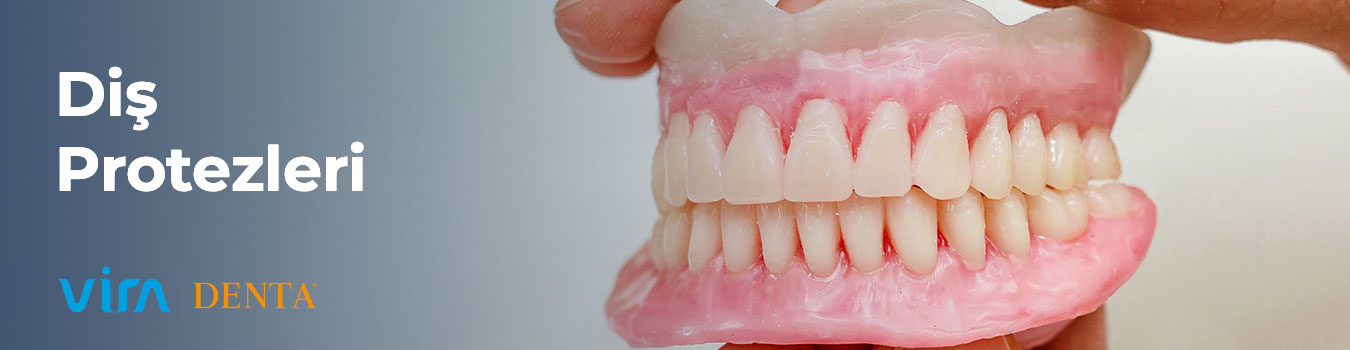
Removable Prostheses
These prostheses are held in place in the mouth by attaching to the gums and the remaining teeth. They can be removed at night or when you are not eating. Some examples of removable prostheses include:
Complete Dentures
Complete dentures are removable teeth made for patients who have lost all of their natural teeth. They are commonly known as false teeth.
Because complete dentures are supported by the soft tissues, they are removable. Since they are taken in and out, they can be more difficult to use than other prostheses, and they do not offer the same comfort and chewing efficiency as fixed prostheses.
Conventional Partial Dentures
These are prostheses that the patient can easily insert and remove, retained by clasps (hooks) that attach to the remaining teeth. They are commonly known as clasp dentures and are made in cases where a fixed prosthesis cannot be applied. A partial denture consists of plastic teeth that replace the missing ones, a pink or gum-colored base, and a metal framework connecting them. Its most important feature is the metal clasps that hold it onto the teeth.
Precision Attachment Dentures
Here, retention is provided not by clasps on the teeth but by crowns and attachments made on the supporting teeth. In cases with a suitable tooth structure, placing precision attachments also avoids the aesthetic drawback caused by clasps. They are also commonly known as snap-on dentures.
Personalized Treatment Planning
Prosthetic treatment is planned individually for each patient. You can contact us via our Contact page for detailed information about your treatment plan.
Article written by:
Dt. Behiye Gün
Please note: The information on this page is for general information purposes only.
For diagnosis and treatment of any health concern, always consult your doctor.
VIRADENTA DENTAL POLYCLINIC
Online Appointment Form
Get information about treatment
Fill in the form and our dental team will call you. If you prefer, you can also continue via WhatsApp after submitting.