

Orthodontics
What Is Orthodontic Treatment?
Orthodontics is the branch of dentistry concerned with correcting crowded teeth and misalignment between the teeth.
Dental irregularities can be caused by hereditary and environmental factors.
Just as dental and jaw irregularities in parents can also appear in their children,
dental and jaw anomalies can also develop from habits such as prolonged bottle or pacifier use, thumb sucking, pen biting and mouth breathing. Preventing these habits at an early age is important for proper skeletal development. Early or late loss of baby teeth can also cause crowding. When baby teeth are lost too early, the permanent teeth may shift and crowding may develop.
Orthodontic treatment is not done for aesthetic purposes alone. If misalignment between the teeth and jaws is left untreated, jaw joint problems can develop because the load on the teeth is not evenly distributed. Orthodontic treatment can help prevent jaw joint problems or stop them from progressing.
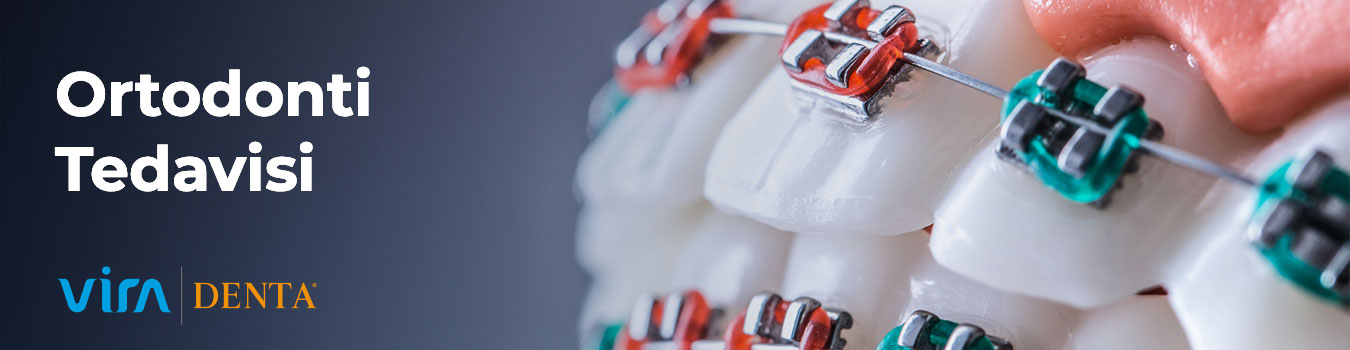
Orthodontic treatment can be carried out with braces, clear aligners and various intraoral or extraoral appliances. Today there are 4 commonly used types of orthodontic treatment. The type of braces used may vary depending on the patient’s structural problem or expectations.
Metal Braces
Metal braces are the most commonly used type of braces. Although they are not the most aesthetic option, they are a treatment method suitable for most problems. Depending on the severity of the problem, correction is achieved in 6 months to 2 years.
Clear (ceramic) braces: there is no difference in treatment outcome. Because the brackets are tooth-colored, they look more aesthetic. However, they are not as durable as metal braces and need to be used more carefully. For this reason, they are not recommended for children.
Lingual Orthodontics
Lingual braces were developed to eliminate the visible appearance of braces. Lingual braces are placed on the inner surfaces of the teeth, which are not visible, rather than on the outer surfaces. They can be used in situations similar to metal or clear braces.
Clear Aligners (Invisalign)
This method, also known as Invisalign, is used for orthodontic problems involving mild tooth and jaw irregularities. Clear aligner treatment does not use wires. Personalized 3D measurements are taken, and custom clear aligners (Invisalign) are prepared for the patient based on these measurements.
Can Orthodontic Treatment Be Done at Any Age?
There is no age limit for orthodontic treatment. However, the duration and planning of treatment may vary depending on the patient’s age. Treatment during the growth period is preferred for correcting misalignment between the jaws.
Sometimes orthodontic treatment may be used to prepare for a prosthesis so that a better prosthesis can be made. This makes the teeth more suitable for the prosthesis. Such treatments are usually completed within 4 to 12 months.
Is Orthodontic Treatment Painful?
Orthodontic treatment is generally well tolerated by patients. However, minor sores may develop on the cheeks within the first few days after the braces are fitted. These sores usually heal within about 1 week.
In rare cases, such as a detached bracket or a broken wire, sores may develop again. Such problems can be resolved with minor adjustments by your dentist.
At the end of orthodontic treatment, it is very important not to neglect retention treatment to prevent the teeth from shifting back. Various appliances can be used during this period.
How Long Does Orthodontic Treatment Take?
The duration of orthodontic treatment can vary from person to person depending on many factors. Some of these factors are:
- Severity of the dental problem: More complex dental problems require longer treatment.
- Patient’s age: In adults, treatment may take longer because the bones are more mature and the teeth move more slowly.
- Rate of tooth movement: Some people’s teeth move faster than others’, which can affect treatment time.
- Treatment method used: Different orthodontic treatments have different durations. For example, clear aligner treatment may take less time than metal brackets.
- Patient compliance: Attending appointments, wearing appliances as instructed and maintaining good oral hygiene can help shorten treatment time.
In general:
- Short-term treatments: Last 6 months to 1 year. These are generally used for simple dental problems.
- Medium-term treatments: Last 1 to 2 years. These are used for more complex dental problems.
- Long-term treatments: Last more than 2 years. These are used for very complex dental problems or cases requiring jaw surgery.
Your orthodontist will give you an estimated treatment time at your first examination. Throughout treatment, your orthodontist will monitor your progress and adjust your treatment plan if necessary.
Personalized Treatment Planning
Orthodontic treatment is planned individually for each patient. You can contact us via our Contact page for detailed information about your treatment plan.
VIRADENTA DENTAL POLYCLINIC
Online Appointment Form
Get information about treatment
Fill in the form and our dental team will call you. If you prefer, you can also continue via WhatsApp after submitting.