
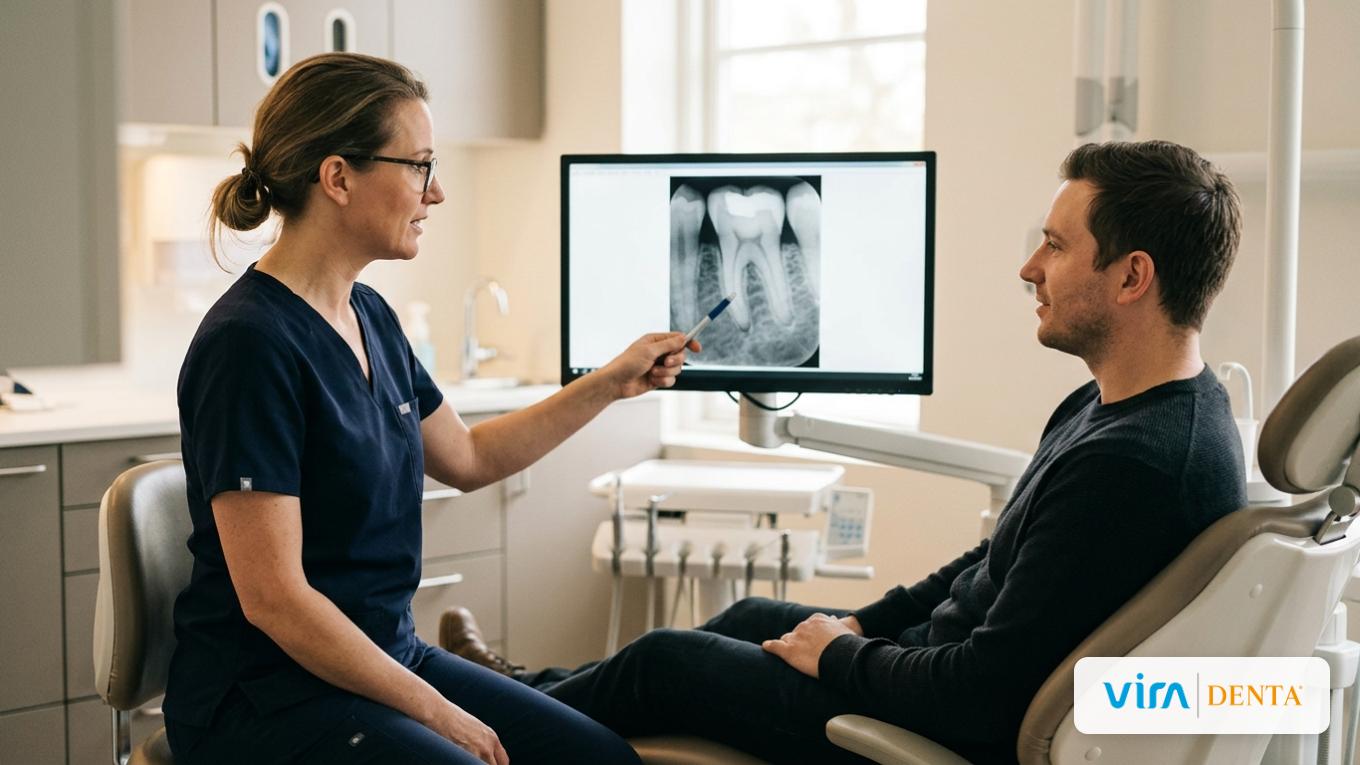

Root canal treatment (endodontic treatment) is performed to save a tooth when the pulp, the tissue inside the tooth that contains nerves and blood vessels, becomes inflamed or infected. Root canal treatment done at the right time can help keep the tooth in the mouth.
When Is Root Canal Treatment Needed?
- Deep decay that has reached the nerve
- Long-lasting sensitivity to hot and cold
- Throbbing pain that starts on its own or gets worse at night
- Swelling or an abscess around the tooth
- Discoloration of a tooth after trauma
The final decision is made after a clinical examination and X-ray assessment.
Treatment Steps
- Diagnosis: The condition of the tooth is assessed with an examination and X-rays.
- Anesthesia: The area is numbed with local anesthesia.
- Access and cleaning: The inside of the tooth is reached, the inflamed tissue is removed, and the root canals are cleaned and shaped with special instruments.
- Disinfection: The canals are rinsed with suitable solutions.
- Root canal filling: The cleaned canals are filled with a biocompatible material.
- Final restoration: The tooth is sealed with a filling or, if needed, a crown.
Depending on the condition of the tooth and the number of canals, treatment can be completed in one or more sessions.
Does It Hurt During Treatment?
Because the procedure is done under local anesthesia, the aim is to keep you comfortable during treatment. After treatment, the tooth may be tender when chewing for a few days; this is usually managed with the pain relievers your dentist recommends.
Aftercare Recommendations
- Do not chew hard foods on that side until the permanent restoration is placed.
- Keep up with your oral care.
- Attend your follow-up appointments.
For more information, you can visit our endodontics page.
Frequently Asked Questions
How long does a tooth with a root canal last?
With a suitable final restoration, good oral care and regular checkups, teeth that have had root canal treatment can be used for many years.
Do I need a crown after a root canal?
For teeth with significant structural loss, a crown may be recommended to protect the tooth against fractures. The decision depends on the condition of the tooth.
Can’t the tooth just be extracted instead of having a root canal?
Whenever possible, keeping the natural tooth is preferred. After an extraction, the gap may need to be filled with an implant or a bridge.
Examination and Appointments
You can meet with our dentists for a personal assessment and treatment plan. ViraDenta is located at Atakent Mah. Reşit Paşa Cd. No: 10/C, Ümraniye/İstanbul, and is open weekdays and Saturdays from 09:00 to 21:00.
Book via WhatsAppCall: +90 216 318 20 20Online Appointment Form
This article is for general information only and does not replace diagnosis or treatment. Please consult your dentist for a personal assessment of your oral and dental health.